
The Artificial Intelligence landscape is moving at an impressive pace. If until yesterday the business debate revolved around chatbots and text generation, today the centre of gravity has shifted: we have entered the era of AI Agents. The latest example is Muse, Meta’s new personal agent, which — unlike a chatbot — does not just answer: it does things on our behalf (for now only in the United States and for adult users).
What does this mean, concretely, for a small or medium-sized business? Let’s start with the ABC.
The AI dictionary: LLM, Chatbot and Agents
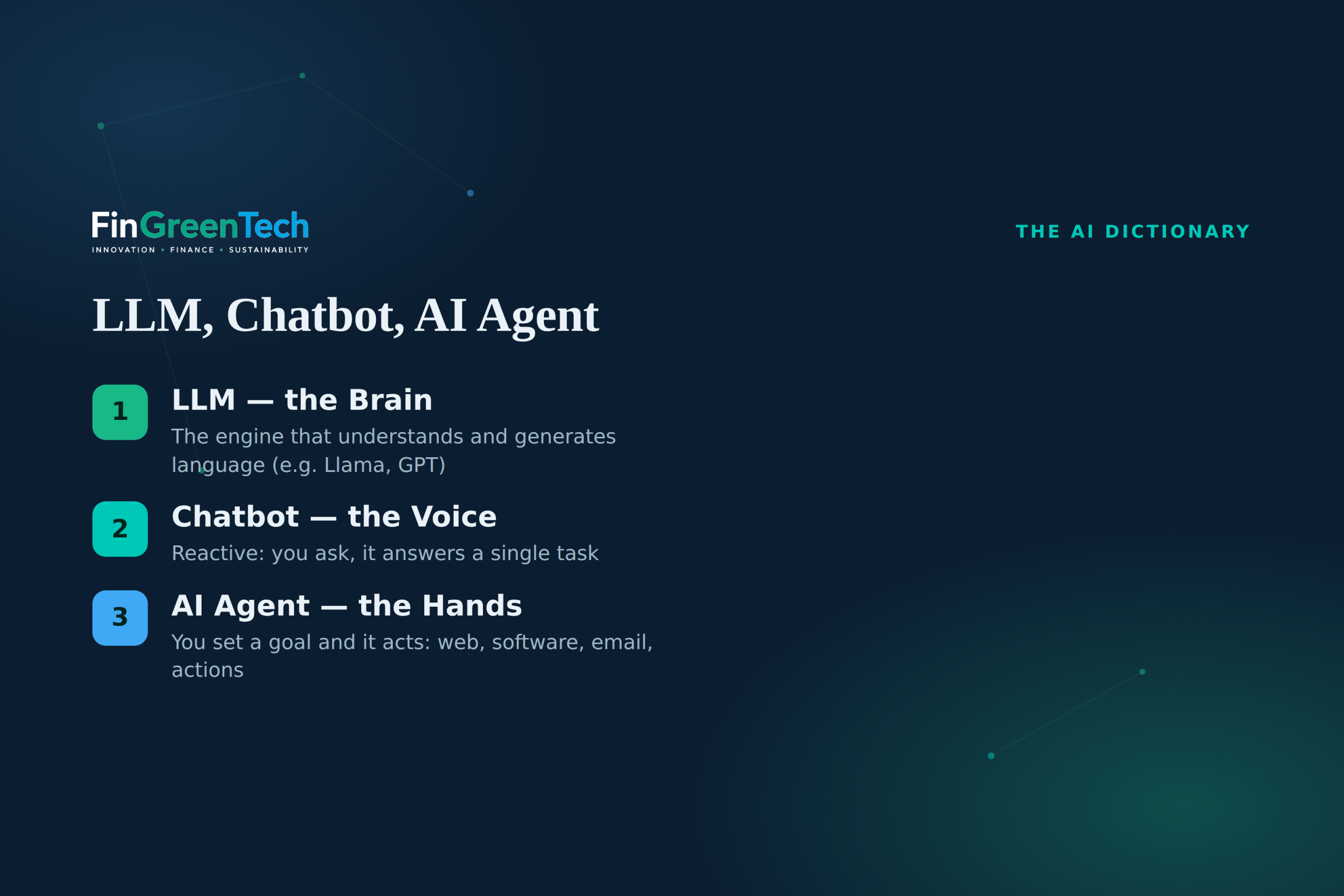
- LLM (Large Language Model) — the Brain. The underlying engine (like Meta’s Llama or OpenAI’s GPT): “pure knowledge”, able to understand and generate language.
- Chatbot — the Voice. The interface we talk to (e.g. ChatGPT). It is reactive: you ask, it answers or performs the single task. And it stops there.
- AI Agent — the Hands. Today’s evolution: you set a goal and it works out and carries out the steps needed, connecting to the web, software, email and platforms. The leap is “from AI that suggests what to do to AI that does it”.
Meta’s Muse: the agent that acts on our behalf
Muse is the most recent example, but it is part of a broader movement: OpenAI, Google, Microsoft (with agents in Copilot) and Anthropic (with Claude) are all moving the same way. What makes it an “agent”, according to Meta:
- It doesn’t answer, it acts. You give it a goal and it reaches it on its own. The example given: take a recipe saved on Instagram, turn it into a shopping list, organise dinner taking guests’ dietary restrictions into account.
- It enters your apps — at the user’s choice. It connects to mail and calendar, payments, shopping, events, restaurants, health, smart home. If a service has an API it uses it; otherwise it navigates the website as a person would.
- It works in the background. It receives a task and keeps handling it even after we close the app, coming back to us only when a decision or authorisation is needed. And it learns from our preferences.
Not just software: meet the “Muse Charm”. Alongside the agent, at Meta Connect the company also unveiled the Muse Charm: a small pocket gadget in a keychain format, about the size of your palm, designed to use the assistant without pulling out your smartphone. You activate it with a tap on the fingerprint sensor in the corner; a small animated display shows an avatar while it listens and replies in real time, and it lets you handle reminders, searches and organization through Meta’s AI agent — without unlocking your phone.
Muse launches in the US on iOS, Android and web, will come to Meta’s AI glasses and will also be usable via WhatsApp; the service is free, with subscriptions for those who need more compute.
What an agent can do for an SME
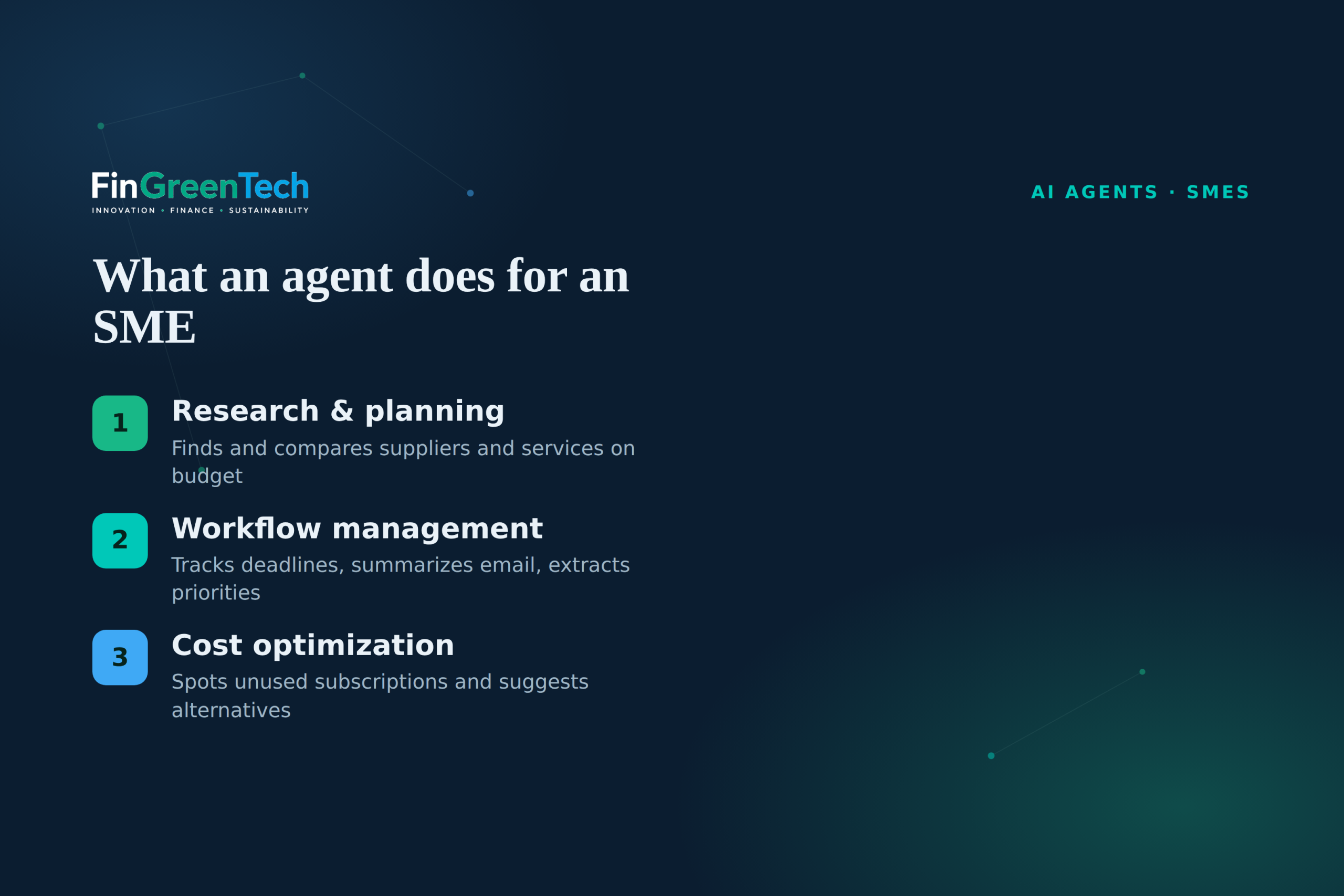
- 🔎 Research and planning — find and compare suppliers or services against budget and requirements.
- 📅 Workflow management — track deadlines, read and summarise long email threads, extract the day’s priorities.
- 🛒 Cost optimization — spot unused software subscriptions, flag renewals, suggest alternatives.
The leap is from systems that know things (LLM) to systems that do things (agents).
Security and governance: the real test
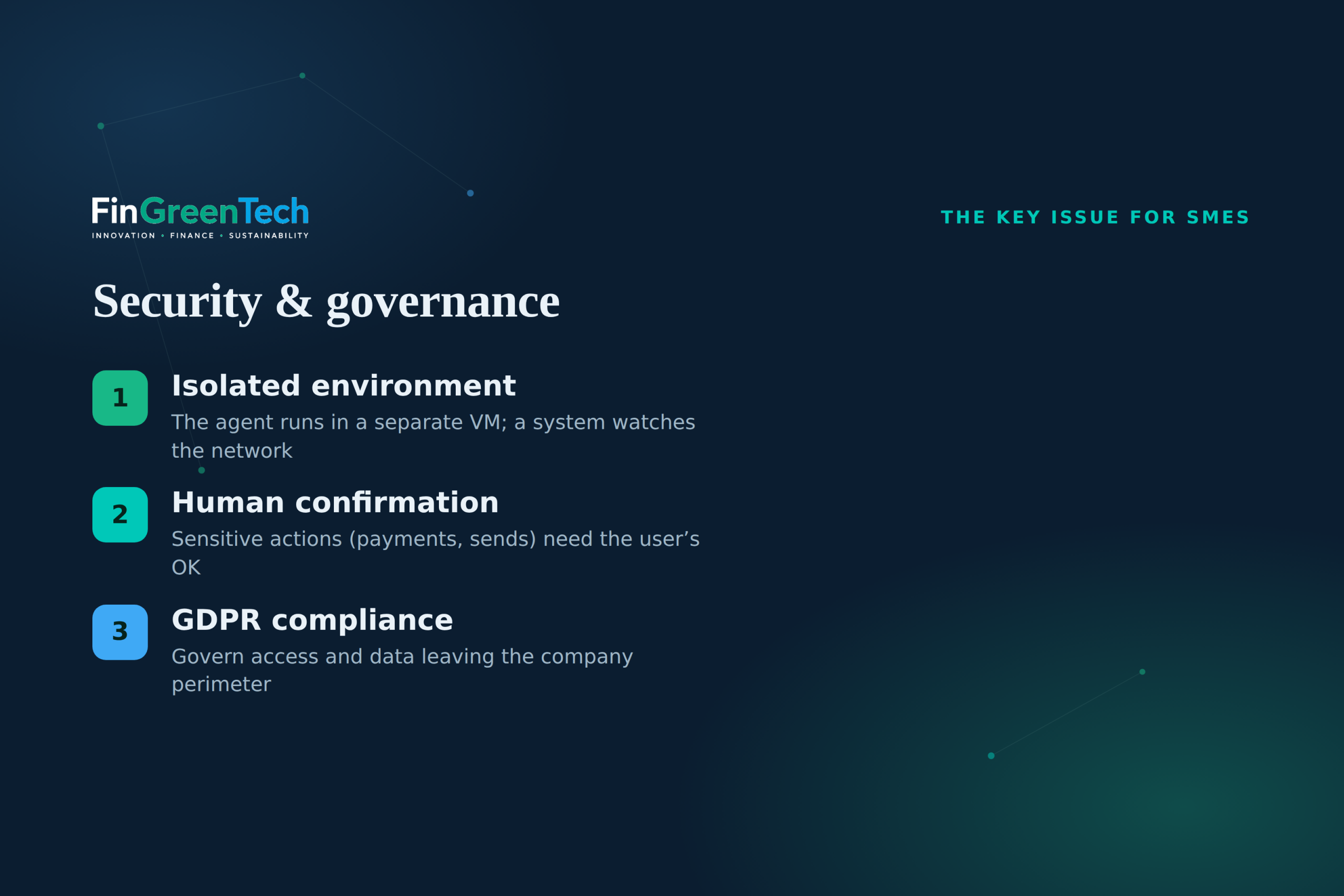
The more power we give an agent, the more security and privacy become decisive. It’s telling how Meta set Muse up: the agent runs inside an isolated environment (Muse Secure VM), a second system (Sentinel) watches operations towards the Internet, the agent does not directly see passwords and payment methods, and sensitive actions — sending an email, completing a purchase — require the user’s confirmation. This is the real test of AI agents: autonomous enough to be useful, without becoming uncontrollable.
For a business the lesson is clear: adopting these tools is not an “app” question but one of security governance — who authorises what, which data leaves the company perimeter, which actions require human validation, how to stay GDPR-compliant.
The impact on productivity
Delegating repetitive research, management and admin tasks to an agent frees people for what matters: strategy, creativity, value decisions. For SMEs it’s a concrete competitiveness opportunity — provided it is governed with care.
Want to understand how to integrate AI Agents and Cloud solutions into your company, securely? FinGreenTech supports businesses and professional firms in choosing the tools, in cybersecurity governance and in identifying the grant financing to fund the upgrade. Book a call → · Write to us →
Transparency note. This article was drafted with the support of artificial intelligence tools and reviewed by the FinGreenTech Team, which holds editorial responsibility. Information on the products mentioned is based on the official announcements and the sources indicated.