Italy’s 2026 budget law (Law no. 199 of 30 December 2025, article 1, paragraphs 427-436) introduced the iperammortamento (“hyper-depreciation”): a tax uplift on the cost of new capital goods, for investments made from 1 January 2026 to 30 September 2028. The Ministry of Enterprises and Made in Italy (MIMIT) presents it as the measure that, in continuity with the Transition 4.0 and 5.0 plans, replaces their tax credits. The operating rules are in the MIMIT-MEF interministerial decree of 7 May 2026, and the GSE platform is now open for all three stages of the procedure. We look at the measure through two lenses that matter to many SMEs: artificial intelligence and green investments.
A note on transparency: we rely on the official texts (Law 199/2025 with Annex V, Decree-Law 38/2026, the interministerial decree of 7 May 2026, the MIMIT directorial decrees and the MIMIT page), but we have not read the GSE’s operating instructions and FAQs. This article is general information, not tax advice: before investing, check your own case with your accountant.
1. How the iperammortamento works
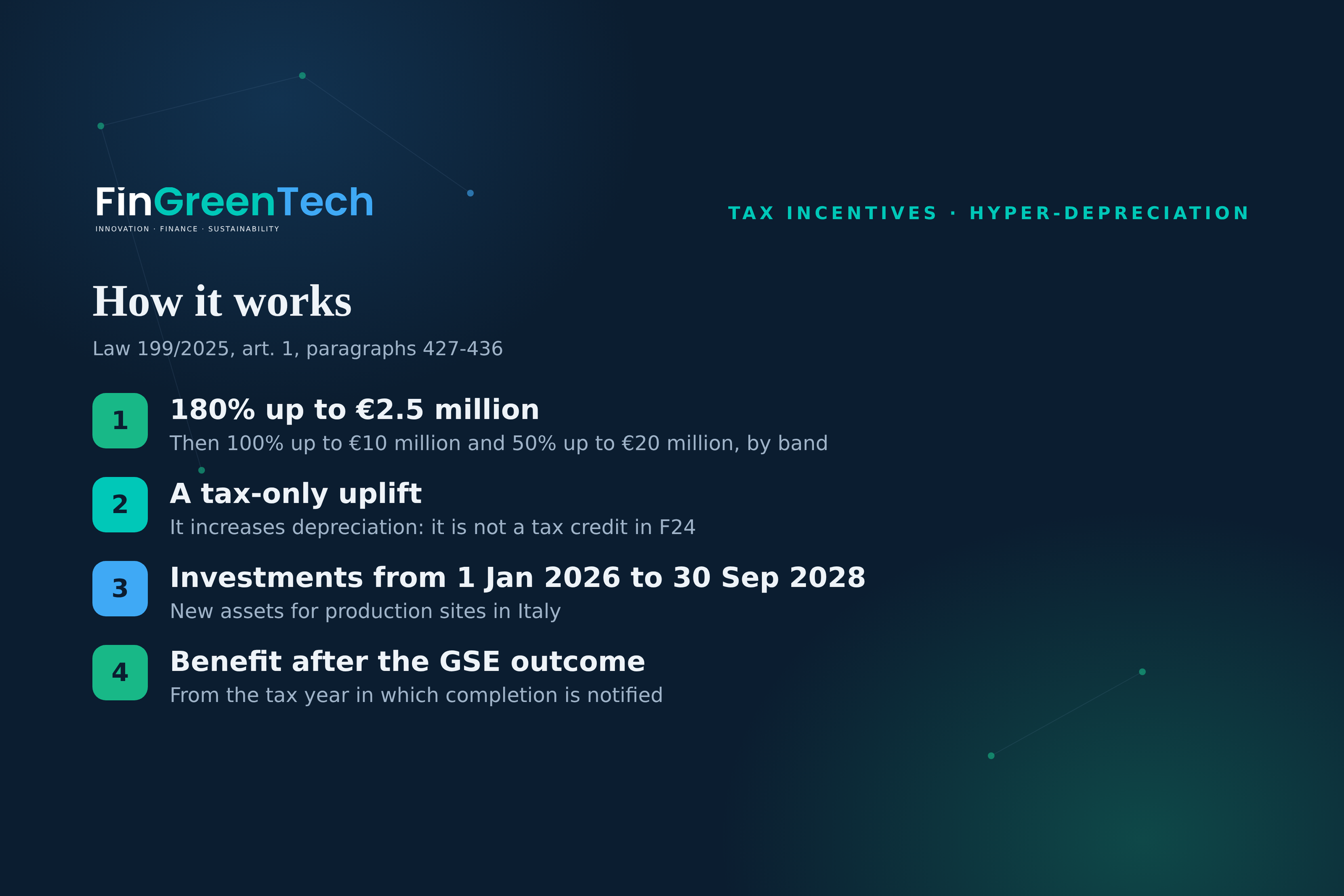
It is not a grant and not a tax credit to offset in form F24. It is an uplift of the acquisition cost of the asset, with tax relevance only, used to calculate depreciation and finance-lease payments. In practice it reduces the taxable base for income taxes only, as MIMIT specifies. The uplift applies by investment band and for each year:
| Investment band (per year) | Cost uplift |
|---|---|
| up to €2.5 million | 180% |
| over €2.5 million and up to €10 million | 100% |
| over €10 million and up to €20 million | 50% |
An example, only to show the logic. On an eligible investment of €1 million, the 180% uplift adds €1.8 million of deductible cost, for €2.8 million to depreciate in total. At the ordinary 24% corporate income tax (IRES) rate, the effect on taxes is about €432,000 more than ordinary depreciation, or 43.2% of the cost. Keep in mind that the deduction is spread over the depreciation years and requires taxable income to use it against: the real result depends on your tax position. For a €3 million investment, the first €2.5 million gets the 180% uplift and the remaining €500,000 gets 100%.
Who can use it. Resident companies and permanent establishments based in Italy, regardless of legal form, sector, size and the tax regime used to determine income. Excluded, among others, are companies in voluntary liquidation, bankruptcy or other insolvency proceedings and those subject to disqualifying sanctions under Legislative Decree 231/2001. Eligibility also depends on compliance with workplace safety rules and the regular payment of social security contributions.
An important change. The original text of the law required goods made in the European Union or the European Economic Area. Article 7 of Decree-Law 38/2026 removed that requirement, with effect for investments made from 1 January 2026. The requirement that the goods go to production sites located in Italy, and the other conditions discussed below, remain.
2. Artificial intelligence: what is in Annex V
Eligible intangible assets are listed in Annex V to Law 199/2025, which replaces and updates the former Annexes A and B of Law 232/2016. For AI the entries are explicit. Among the software, systems, platforms and applications of “advanced artificial intelligence” are:
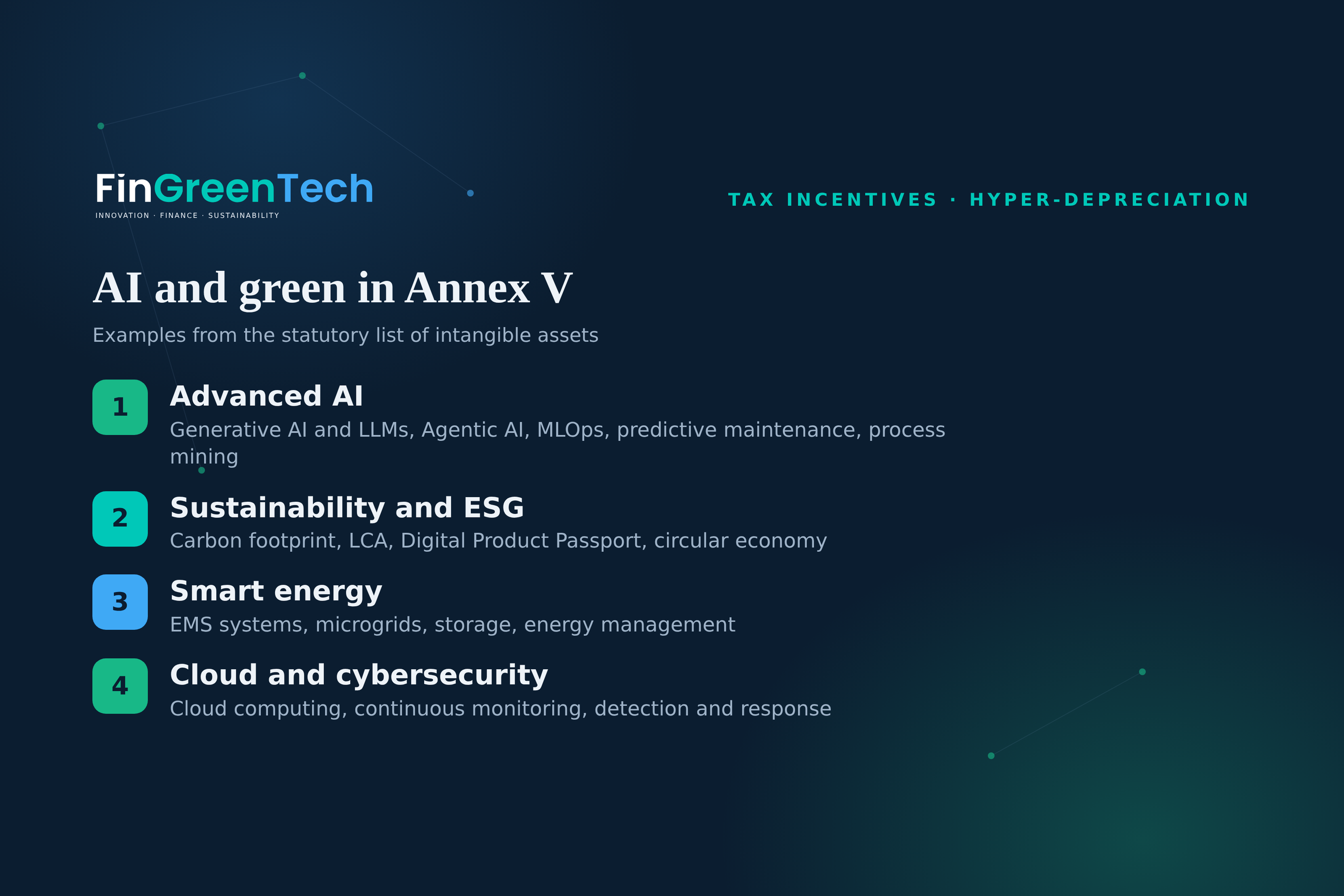
- generative AI and large language models (LLMs) for generating content, technical documentation and code and for supporting decision processes;
- autonomous AI (Agentic AI), able to perform complex tasks and orchestrate workflows in operational processes;
- MLOps platforms for managing the lifecycle of models, with versioning, monitoring and deployment;
- AI for predictive maintenance, to anticipate failures and optimise maintenance work;
- process mining, to analyse and optimise business processes starting from system data.
The list also includes AI and machine learning that safeguard the quality of the production process, decision-support systems running on cloud or edge devices, and low-code and no-code platforms for industrial applications and process automation.
Being on the list is not enough. The asset must be new and must be interconnected to the company’s production management system or supply network. An AI assistant used in isolation, without a link to the company’s systems, is unlikely to meet this requirement, and interconnection must be proven with a technical report. We cannot tell you in advance whether a specific project qualifies: it depends on what is bought, how it is integrated and how it is documented.
What about SaaS subscriptions? Interpretations differ on this point. Annex V lists cloud computing and cloud-based platforms, but in the official texts we have read we find no explicit rule on how to treat service fees against the “acquisition cost” of an asset. So we cannot tell you that they are eligible or that they are excluded: ask the GSE and your accountant for confirmation before you decide.
3. Green investments: from software to energy
The green side of the measure has two components.
Software and platforms for sustainability (Annex V). The intangible assets include systems to calculate, monitor and optimise the carbon footprint of products and processes, life cycle assessment (LCA) and ESG performance management; platforms for the Digital Product Passport, integrated with PLM, ERP and MES systems; and software for waste management, the circular economy and end-of-life. On energy there are systems for smart energy management (consumption optimisation, storage, load balancing, energy dashboarding, power quality) and EMS systems for microgrids and the integration of renewables and storage, with functions such as peak shaving and demand response.
Renewable energy self-production. New tangible assets for renewable self-production intended for self-consumption, including remotely, are also eligible, storage systems included. The decree sets the sizing rule: the expected output of electricity plants cannot exceed 105% of the production site’s energy needs, calculated on the average annual consumption of the previous financial year. For photovoltaics, only the modules indicated in article 12, paragraph 1, letters b) and c) of Decree-Law 181/2023 count, and the decree sets maximum eligible cost parameters expressed in euro per kW.
Cybersecurity is on the list too: platforms to protect networks, data and plants with continuous monitoring, anomaly detection and automated response (detection and response). For companies adapting to the NIS2 directive, which we covered in our NIS entities vademecum, it can be an opportunity to evaluate, always under the legal conditions.
4. The conditions not to underestimate
- New, interconnected goods, in Italy. The investment must concern new goods, intended for production sites located in Italy and interconnected to the company’s production management system or supply network.
- Sworn technical report. The characteristics of the goods and their interconnection are proven with a report issued by an engineer or industrial expert registered with their professional body, or by the attestation of an accredited certification body, with suitable insurance cover.
- Accounting certification. The actual incurring of the expenses must be shown by a certification issued by a statutory auditor or an audit firm.
- Cumulation. The uplift can be combined with other national and European incentives, provided they do not cover the same cost portions and the cost incurred is not exceeded; the calculation base is net of contributions received. It does not apply to investments that benefit from the Transition 5.0 tax credit (Law 207/2024, article 1, paragraph 446).
- Disposal of the asset. If during the benefit period the asset is sold or moved to a site abroad, the remaining portions of the benefit are kept only if, in the same tax year, it is replaced with a new asset with similar or superior technological characteristics.
5. The GSE procedure, step by step
All notices go through the GSE’s Customer Area, accessed with SPID or CIE, and must be filed for each production site to which the investments relate.
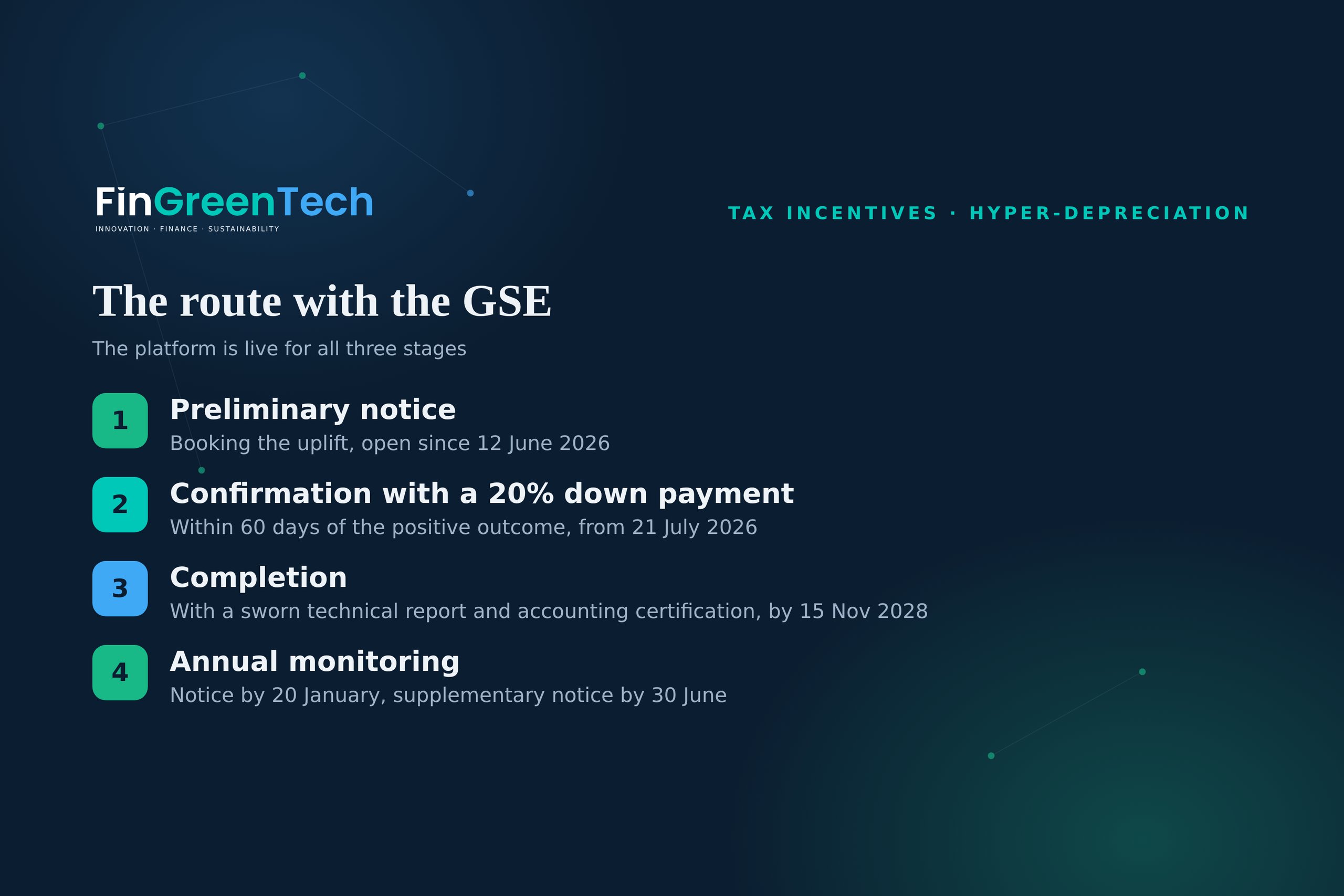
- Preliminary notice. It books the uplift, with details of the company, the goods, the amounts and the expected interconnection date. The platform has been open since 12:00 on 12 June 2026.
- Confirmation notice. It must be sent within 60 days of the positive outcome of the preliminary notice, with the date and amount of the payment that brings the down payment to at least 20% of the cost of each asset, and the invoice details. For finance leases the 20% is deemed met with the contract and the commitment made with the supplier. Platform open since 12:00 on 21 July 2026.
- Completion notice. It is sent once the investment is complete and the goods are interconnected, by 15 November 2028 (extended by 20 days if the GSE requests additional documents), with the sworn technical report and the accounting certification. It cannot cover goods other than those, or amounts higher than those, in the confirmation. Platform open since 12:00 on 15 October 2026.
- Monitoring. Until the end of the benefit period, a periodic notice is due by 20 January each year and a supplementary one, with the depreciation plan, by the following 30 June.
The GSE checks the completeness of the data within ten days of the submission receipt, and the uplift applies from the tax year in which the completion notice is sent, provided the asset came into operation in the same year and the GSE gave a positive outcome. If the notices are not sent within the deadlines and in the manner required, the procedure is not completed.
6. Five mistakes to avoid
- Assuming that “AI” means eligible. What counts is that the asset is in Annex V, is new and is interconnected with company systems, and that everything is documented.
- Treating interconnection as a detail. It is an essential condition, to be proven with the report and maintained.
- Getting the timing of orders and down payments wrong. The decree’s sequence starts with the preliminary notice, and the confirmation, to be sent within 60 days of the positive outcome, states the payment of a down payment of at least 20%: coordinate orders and payments with your adviser.
- Changing the goods between confirmation and completion. Different goods and higher amounts than those confirmed are not allowed.
- Forgetting about cumulation. The hyper-depreciation and the Transition 5.0 credit cannot be combined on the same investments, and with other aid the calculation base is reduced.
7. What to do now
If you plan investments in AI, cloud, energy efficiency or self-production, the first step is a mapping: which assets, which Annex V entries, how well they integrate with your systems and who will sign the report and the certification. Then the calendar is built with your accountant, keeping the GSE deadlines in mind. The measure runs until 30 September 2028, but good planning avoids ending up against the deadlines.
Are you evaluating investments in AI, cloud or cybersecurity and want to fit them into a well-built project? Book a free introductory call with FinGreenTech or write to us at info@fingreentech.com. For the tax aspects, we recommend involving your accountant.
Sources: Law no. 199 of 30 December 2025, article 1, paragraphs 427-436 and Annexes IV and V (Gazzetta Ufficiale); Decree-Law no. 38 of 27 March 2026, article 7 (Normattiva); MIMIT page “Nuovo Piano Transizione 5.0 – Iperammortamento” (in Italian); MIMIT-MEF interministerial decree of 7 May 2026 and the MIMIT directorial decrees of June, July and October 2026 on the opening of the GSE platform.
Transparency note. This article was drafted with the support of artificial intelligence tools and reviewed by the FinGreenTech Team, which is editorially responsible for it.