
On 12 October 2026 Stanford HAI presented the findings of research led by Diyi Yang, with Yijia Shao and Dora Zhao, accepted by Nature Human Behavior. In collaboration with Anthropic, the team analysed about 250,000 anonymised conversations between people and the Claude chatbot, to understand what kind of work we bring to AI, how much initiative we take, and where the exchange breaks down. We pick up the thread of our article on AI agents with an educational angle: what the data say, what to avoid, and how to make our interactions more useful.
A note on transparency: we rely on the account published by Stanford HAI, not on the full text of the research, and the data concern conversations with a single chatbot. The practical tips below are ours: they point in the direction indicated by the study but are not part of it.
1. What was studied
The researchers asked three questions: is the work we bring to AI really important? How much initiative (agency) do we take in the conversations? And where does the collaboration produce “friction”, whether useful or paralysing?
2. The positive findings
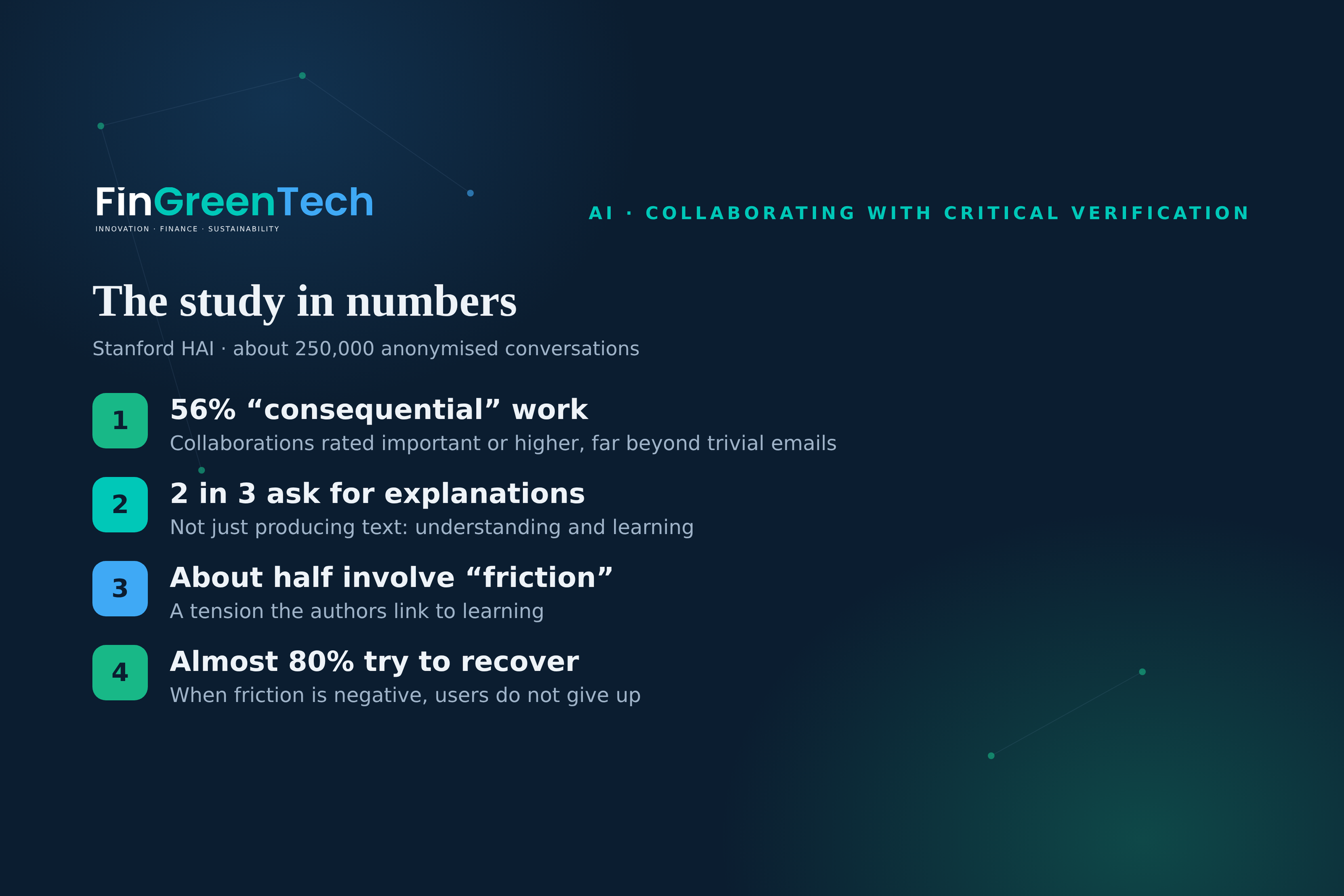
- The work is often consequential. 56% of collaborations were rated “consequential” or higher. Trivial examples, such as drafting an email, exist, but the authors find high-stakes, hard-to-reverse tasks much more common.
- The higher the stakes, the more engagement. Conversations about the most important work last nearly twice as long as those about ordinary tasks.
- Explaining, not just producing. In two out of three interactions people ask the AI to explain or teach, not only to generate content. AI teaching proved most helpful in areas such as law, software engineering, home improvement and health.
- Friction can be good. About half of the conversations contain friction, a tension the authors link to learning. And when the friction is negative, in almost 80% of cases the user tries to get things back on track.
In short, according to Yang most users do not treat AI as a “free lunch”: they stay involved, and this improves the result.
3. What to avoid
- Delegating everything and accepting what comes back. This is the risk the researchers stress: offloading work to AI without scrutiny.
- Intellectual capitulation. Among the concerns raised is that of a “de-skilled” workforce that loses skills by relying on AI passively.
- Letting negative friction end the exchange. When the AI contradicts you or misunderstands, you need to be able to pick up the thread, not give up.
- Widening the gap. The authors worry that the benefits will concentrate in high-stakes knowledge sectors, widening the distance from everyone else.
4. An amplifier, not a bible
AI, agents, chatbots, language models, coding assistants: for us they are always amplifiers of human intelligence, never substitutes and never oracles. An amplifier multiplies what it finds. Those who are curious, do not stop at the first answer, question it, ask why and try alternatives, come out stronger. Those who settle, delegate without looking and take what they read at face value remain exposed to the risk of getting it wrong and not finding solutions: multiplying passivity leads nowhere good.
It is not a matter of being “smart” or not: it is an attitude, and it can be trained. Curiosity and a critical mind can be cultivated, in ourselves and in our teams. Those who treat AI like a bible, a text not to be questioned, shift onto it a responsibility that remains ours. It is also what the Stanford researchers fear: intellectual capitulation and a growing gap between those who use AI actively and those who simply rely on it. And since users also turn to it for legal, medical and financial matters, the point weighs even more.
5. The most common mistake, in two words: critical verification
The most frequent mistake is to take the confidence with which AI answers as a guarantee that it is right. A fluent, self-assured text is not a verified text. Two words are enough to avoid it: critical verification.
6. Three tips to take home
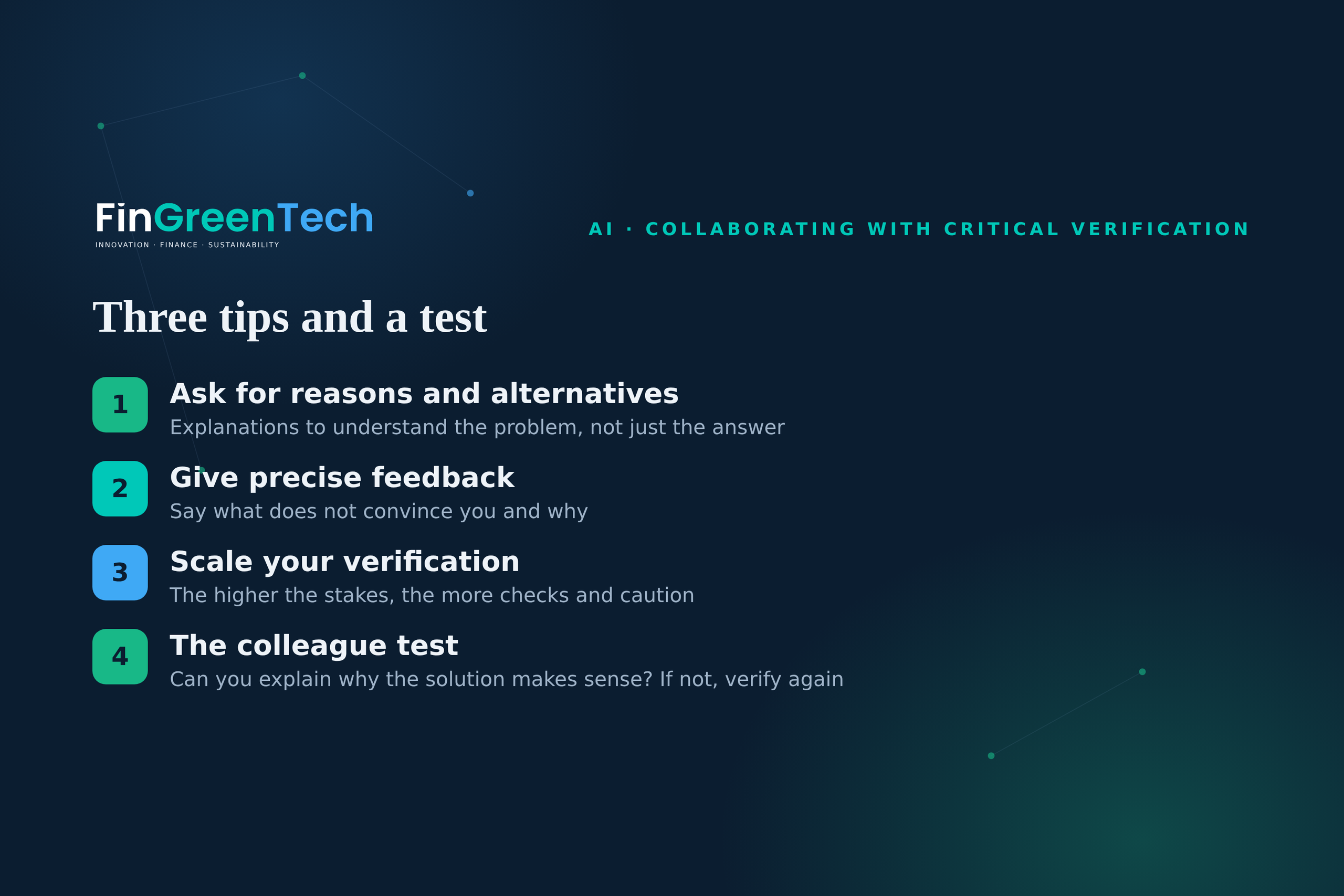
- Ask for reasons, alternatives and explanations. Do not stop at the answer: ask why, what other routes exist and what would change in the conclusions. It helps you understand the problem, not just obtain a text.
- Give precise feedback. Not “I’m not convinced”: say what does not convince you and why. Specific friction produces a useful correction; vague friction produces just another confident answer.
- Scale verification and caution to the stakes. For a draft email a careful read is enough; for a legal opinion, health data or a financial commitment you need sources, independent checks and a person who answers for it.
A practical test of whether you have understood: try explaining to a colleague why that solution makes sense. If you can do it in your own words, and say what would disprove it, you have made it your own. If not, verification is not over.
7. The next step: tools, not just instructions
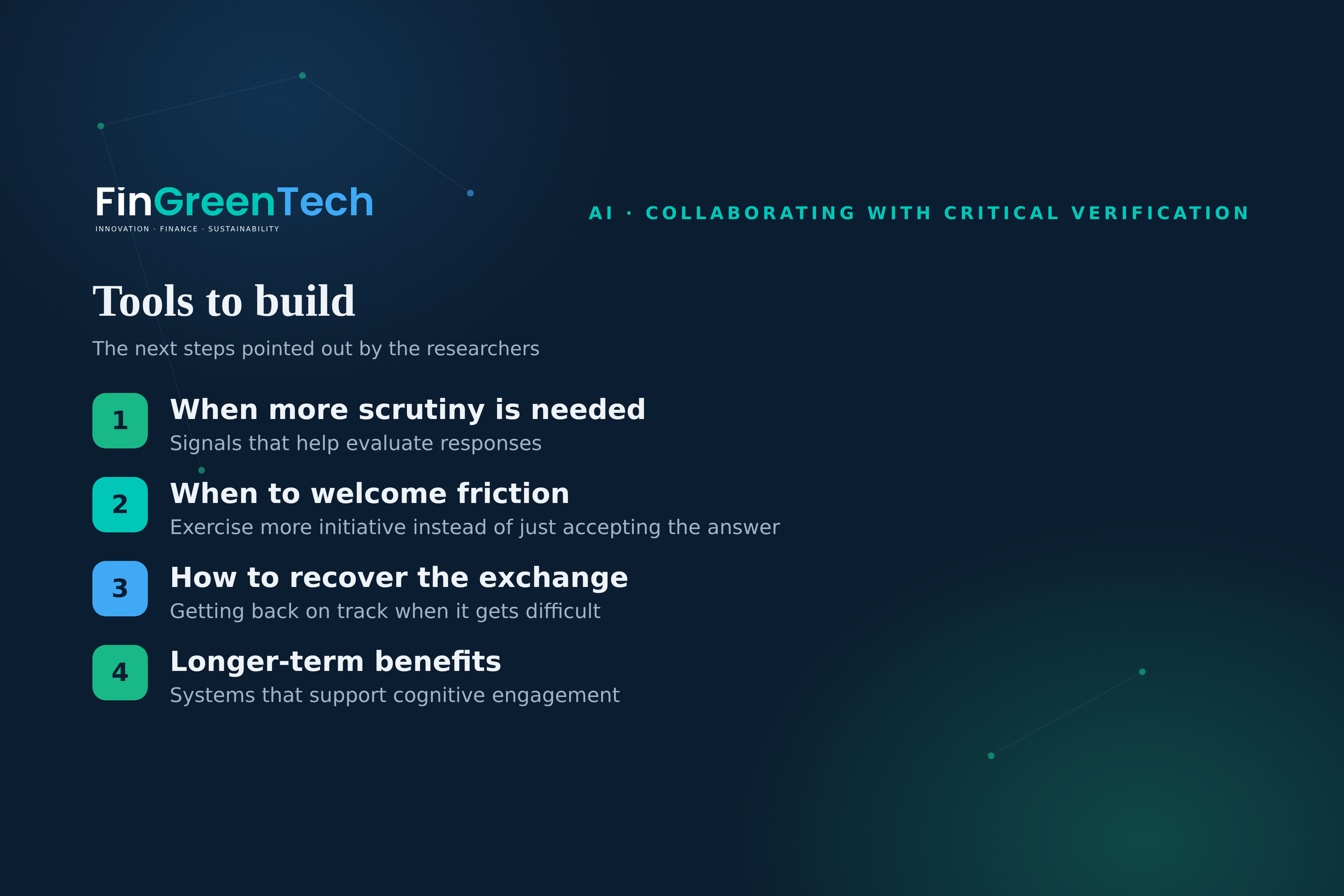
Among the next steps indicated by Shao are tools that help people recognise when a response needs more scrutiny, when to welcome friction and exercise more initiative, and how to get back on track when the exchange gets difficult. Dora Zhao looks instead at personalisation and at systems that support longer-term benefits, such as greater cognitive engagement.
It is a good place to close: it is not enough to teach people to use AI better; we also need to build AI that helps them exercise their own ability to decide, with signals about reliability, alternatives close at hand and human confirmation at important steps.
8. What it means for those who use AI at work
- The stakes are already high. If more than half of the work done with AI is consequential, verification cannot be left to individual goodwill: you need a shared method, with rules on what is checked, by whom and how a trace is kept.
- Friction is a resource, not a flaw. Workflows that remove every question and every confirmation in the name of speed also remove the moment where people learn and correct.
- Training matters as much as the tool. Those who know how to ask for explanations and recognise AI’s limits get more out of it; for people and for companies, the risk of losing skills is real.
- Product choices shape behaviour. When you evaluate an AI tool, ask how it helps you verify: sources, alternatives, signals of uncertainty, human confirmation for sensitive actions.
- The gap is not only about access. If the benefits risk concentrating in a few sectors, looking after how AI is used, with a critical mind and up-to-date skills, is part of the answer.
Want to introduce AI in your company with the right method and controls? Book a free intro call with FinGreenTech or write to info@fingreentech.com.
Source: Stanford HAI, Andrew Myers, “Humans and AI Engage in Meaningful Collaborations” (12 October 2026).
Transparency note. This article was drafted with the support of artificial intelligence tools and reviewed by the FinGreenTech Team, which is editorially responsible for it.