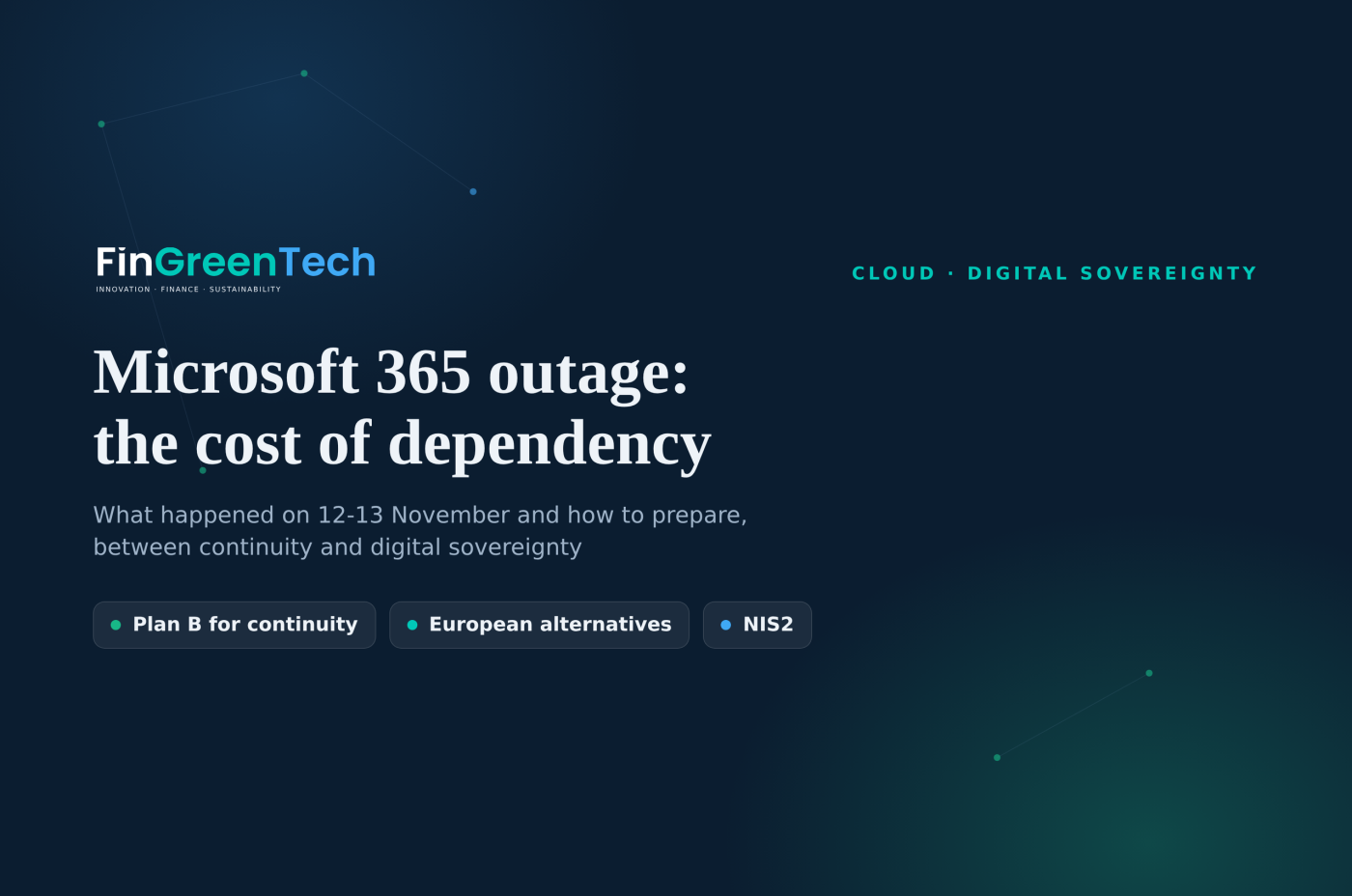
On Thursday 12 November 2026, in the late afternoon Italian time, Outlook, Teams and Copilot stopped working for millions of users. The problems lasted about a day (sources report durations between 24 and 36 hours), with effects reported in 74 countries and territories. Microsoft stated it had no indication of a cyberattack and spoke of a technical fault. For many companies, though, the question that matters is not «whose fault is it?» but «how much does it cost us to stand still, and what do we do if it happens again, perhaps for longer?»
A note on transparency. FinGreenTech is an official Microsoft partner and recognises the role the company has played, and still plays, in the history of computing and in the daily work of millions of businesses. This is not an article against Microsoft: outages happen to every large provider, and to anyone who runs infrastructure in-house too. The point is a different one, and it concerns our side of the Atlantic: European digital sovereignty and a company’s ability to keep working when a service it depends on stops. We also declare an interest: we offer cloud services and infrastructure in Italy, so read our conclusions with that in mind.
1. What happened, based on the sources we read
We list only what is confirmed by several sources and by Microsoft itself, separating it from hypotheses.
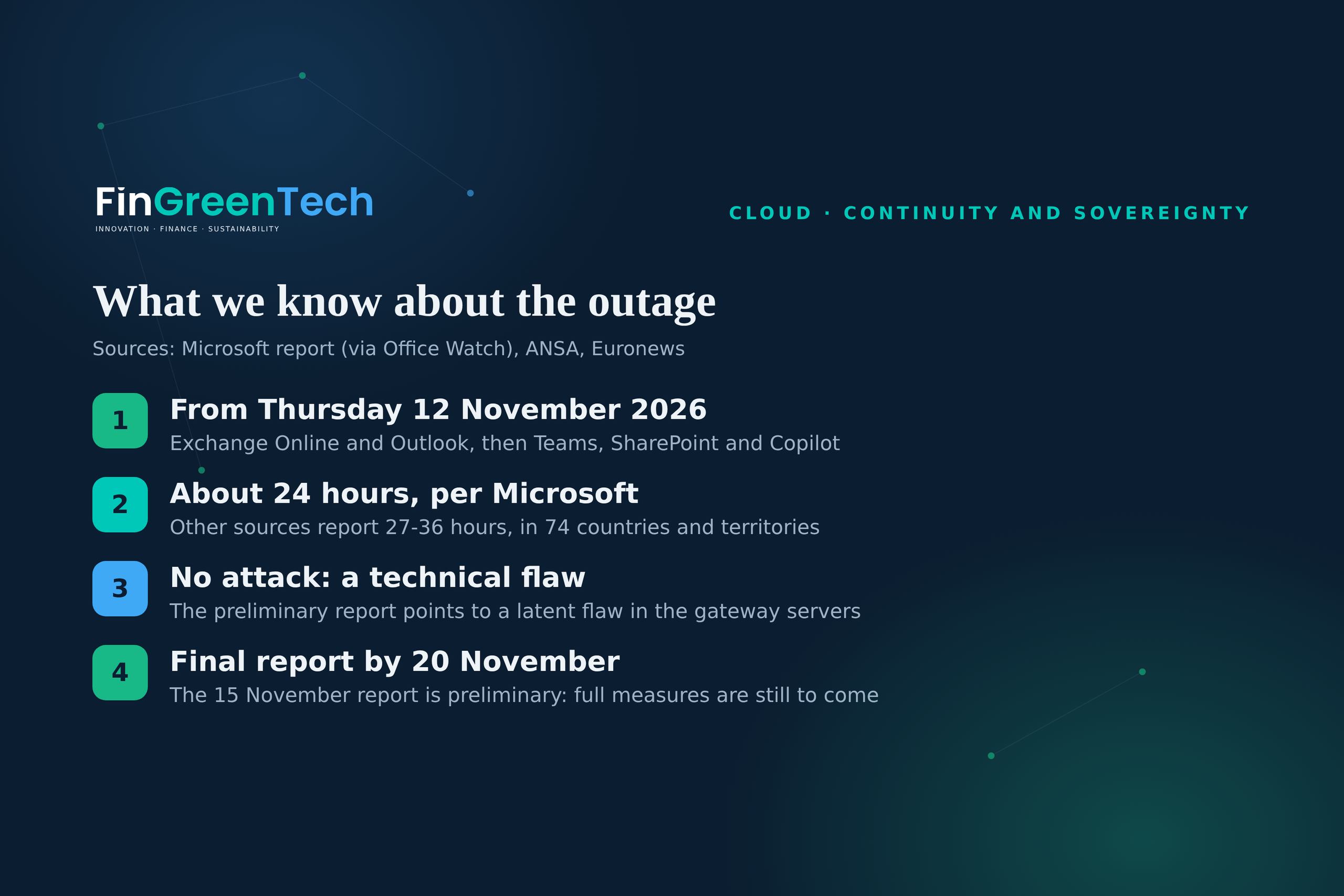
- Start and duration. According to Microsoft’s preliminary report of 15 November (as reported by Office Watch and Wccftech), the impact began at 16:20 UTC on Thursday 12 November (5:20 pm in Italy) and ended at 16:10 UTC on Friday 13 (5:10 pm), about 23 hours and 50 minutes; webmail was back to normal globally at 14:17 UTC (3:17 pm in Italy). Press figures differ: ANSA spoke of almost 24 hours; The Register, on the evening of Friday 13, of more than 27 hours, with recovery still under way; Punto Informatico of a problem definitively resolved on the morning of Saturday 14, after about 36 hours in total. When working out the cost of an outage, how you measure its end matters too: for all users, or for the first recoveries.
- Services involved. Mainly Exchange Online and Outlook, then Teams, SharePoint, Copilot and Defender XDR, with reports about other services too. Microsoft notes that Microsoft 365 is used by more than 430 million people.
- Knock-on effects. According to the press, public offices, universities, healthcare and airlines were affected: ANSA mentions Palazzo Chigi and many Italian universities, Euronews British medical practices that asked patients to phone instead.
- Cause stated during the outage. Vice president Charles Lamanna said Microsoft has no indication of an attack or malicious activity. It explained that many servers became «unexpectedly unavailable» after failing automated health checks and that load shifted to the remaining servers, which in turn became overloaded, while traffic had not increased. In a later update it linked the incident to an issue that emerged during an earlier network capacity upgrade and surfaced after a recent network change, stating that it had fixed the problem at its root and restored services gradually, validating stability at each step.
- The preliminary report. On 15 November Microsoft published a Preliminary Post Incident Report for administrators (ID EX1550543). The original document is visible to administrators in the admin centre and has no official public address: we read a PDF copy published by Next.ink and Office Watch’s full reproduction, which match each other, but we cannot verify that the PDF is identical to the original. The content we report matches what Office Watch and Wccftech relayed on 16 November. According to these sources the cause is the sum of three elements: a latent flaw in a Windows fix deployed since July 2026 on the Microsoft 365 «gateway» servers (the front door), which under load makes servers exhaust processor and memory; the automatic shift, about 15 hours earlier, of Teams traffic onto the same gateway used by Exchange Online; and about 14% of capacity already out of service because of an unrelated problem the previous day. Automatic redirection of traffic to the remaining servers amplified the failure, until more than 80% of the gateway servers stopped responding, in under two hours. A standard rollback could not be used because the change dated back months. Microsoft restored the previous version of the code that handles connections. Wccftech specifies that the flaw concerns the gateway infrastructure and not Windows in general.
- What we do not know. The 15 November report is preliminary: Microsoft indicates that the final report, with the full list of corrective measures, will arrive by 20 November. We could not verify the original document (we only read third-party copies) and the number of affected users has not been published: «more than 430 million» is Microsoft 365’s user base, not the number of people affected. This article will need updating when the final report comes out.
Two useful notes. First: to reduce the risk of losing messages, Microsoft extended the email retry window to 48 hours. Second: as always during an outage, phishing emails appeared inviting people to «restore the mailbox». Euronews, based on the information available, describes the episode as an access problem rather than a data theft. Neither point reduces the operational damage: for hours, many companies could not write, schedule meetings or retrieve contacts.
A contractual note. According to Microsoft’s training documentation, the service credits provided by SLAs are a discount on the fees of the service that fell short, not a cash refund, and they are not applied automatically: the customer requests them, through the administrator, with a claim to Microsoft (those who buy through a partner go to the partner). The thresholds and percentages that apply to Exchange Online must be checked against the SLA text and your own contract, which we have not analysed. As in any such case, the credit does not cover the cost of an outage: for that you need the calculation described below.
2. The problem is not the cloud: it is concentration
The headline of the Cyber Security 360 analysis sums up the issue well: the real problem is not the cloud, but who decided to depend on it. Its summary speaks of technological concentration risk: IT choices that are each correct can, added together, create a critical dependency for the business. Email, calendar, meetings, documents, identity and now the AI assistant often sit under the same provider and the same infrastructure. If one layer stops, everyone’s work stops.
Experts quoted by the press point in the same direction. An Imperial College analyst observed that the episode once again shows the downside of depending so heavily on a handful of large US tech companies. Another commentator recalled that, in theory, good practice would be to have a second service, but in reality almost no company can function without tools like Microsoft’s. Both are right: replacing everything is unrealistic, preparing nothing is risky.
It is also worth distinguishing the risk of availability (the service stops because of a fault) from that of jurisdiction (the service is subject to the laws and decisions of another country). They are different things, but they add up. In June 2025, before a French Senate committee, a Microsoft France executive answered that he could not guarantee that French citizens’ data would not be handed to US authorities without the French government’s consent, adding that it had never happened so far; Microsoft stated that it would challenge unfounded requests. In October 2025 the International Criminal Court confirmed its move from Microsoft Office to openDesk, the German open source suite, after US sanctions on some of its officials: according to the press the chief prosecutor reportedly lost access to his email, but Microsoft’s president denied that services had been cut. We cite these cases not to side with anyone, but because they show scenarios a European company may want to include in its risk plan. Red Hot Cyber also observed, on 13 November, that a data centre in Europe does not make a service sovereign if the technology that runs it is controlled by a non-EU supplier. It is the author’s opinion, but it matches the distinction we draw in this article. We also discussed this in Data sovereignty: servers in Italy are not enough.
There is also a third, less visible aspect: skills. An analysis published by Agenda Digitale on 29 September recalls that sovereignty is not only a matter of contracts and licences: it distinguishes the possibility of changing supplier from the ability to do so, which depends on people and in-house skills. To measure it, it suggests asking, for example, how long it would take to replace a supplier of essential functions.
3. Europe is on the move: from statements to facts
On 3 June 2026 the European Commission adopted a technology sovereignty package that includes two legislative proposals (a Chips Act 2.0 and a Cloud and AI Development Act), a European open source strategy and a communication on technology sovereignty. The Commission recalls, citing a 2022 estimate, that the Union depends on third countries for more than 80% of the main digital products, services, infrastructure and intellectual property.
States are moving to action too. According to Agenda Digitale (25 May 2026), the Commission applied its Cloud Sovereignty Framework, introduced in October 2025, to a 180 million euro tender for sovereign cloud services, awarded in April 2026 to four European providers, while France and Germany translate commitments into migrations and open formats. To give the scale of dependency, the same article reports that the German federal government pays Microsoft almost half a billion euros a year in licences alone. As for Italy, the analysis notes that we have a solid base, with the 2021 Italian Cloud Strategy and ACN’s qualification of cloud services, which also rewards legal and operational autonomy, but that a national plan to replace US software comparable to those of Paris and Berlin is still missing. This is the author’s assessment, which we find useful to know.
Two caveats, from the same analysis. First: concentration is not only about Microsoft, as it also recalls the global Amazon Web Services blackout of October 2025, attributed to the malfunction of a single data centre. Second: the risk of «sovereignty washing». Locating data locally and controlling encryption keys reduces many governance risks, but does not remove the provider’s subjection to extraterritorial rules, as Cristina Caffarra of the EuroStack initiative points out. That is why several European operators support a layered approach: the most sensitive data stays in Europe under full local control, and the less sensitive components are entrusted to the large providers. It is the most realistic reading of this episode: not «all or nothing», but a choice about where to keep what.
A picture of the market and of Italian companies comes from the Osservatori Digital Innovation of Politecnico di Milano, which on 17 November presented its research «Digital Sovereignty: between utopia and necessity». According to the data presented, 92% of European cloud revenue (IaaS and PaaS) is in the hands of US providers and 68% in those of Amazon, Microsoft and Google alone; across the 13 main European hubs, 49% of data-centre IT power is concentrated in the ten largest non-EU operators, and 45% of the investment planned in Italy over the next three years (EUR 25 billion) comes from three US cloud hyperscalers. A survey of 203 CIOs and 50 CISOs of medium-large Italian companies, which the Osservatori themselves state has no statistical significance, indicates that data location and protection and service continuity are the sovereignty criteria most considered when choosing suppliers, and that more than one respondent in three has changed a purchasing decision in the last 12 months for this reason; among those who had to accept a trade-off, the most frequently cited is higher cost. For companies, the research suggests mapping critical suppliers, classifying workloads, preparing an exit plan and starting where alternatives are mature, such as productivity and collaboration. One caveat: we only read the presentation slides, not the full report, and we have not verified the sources behind the data.
4. How much does it cost to stop for 24 hours, a week or more?
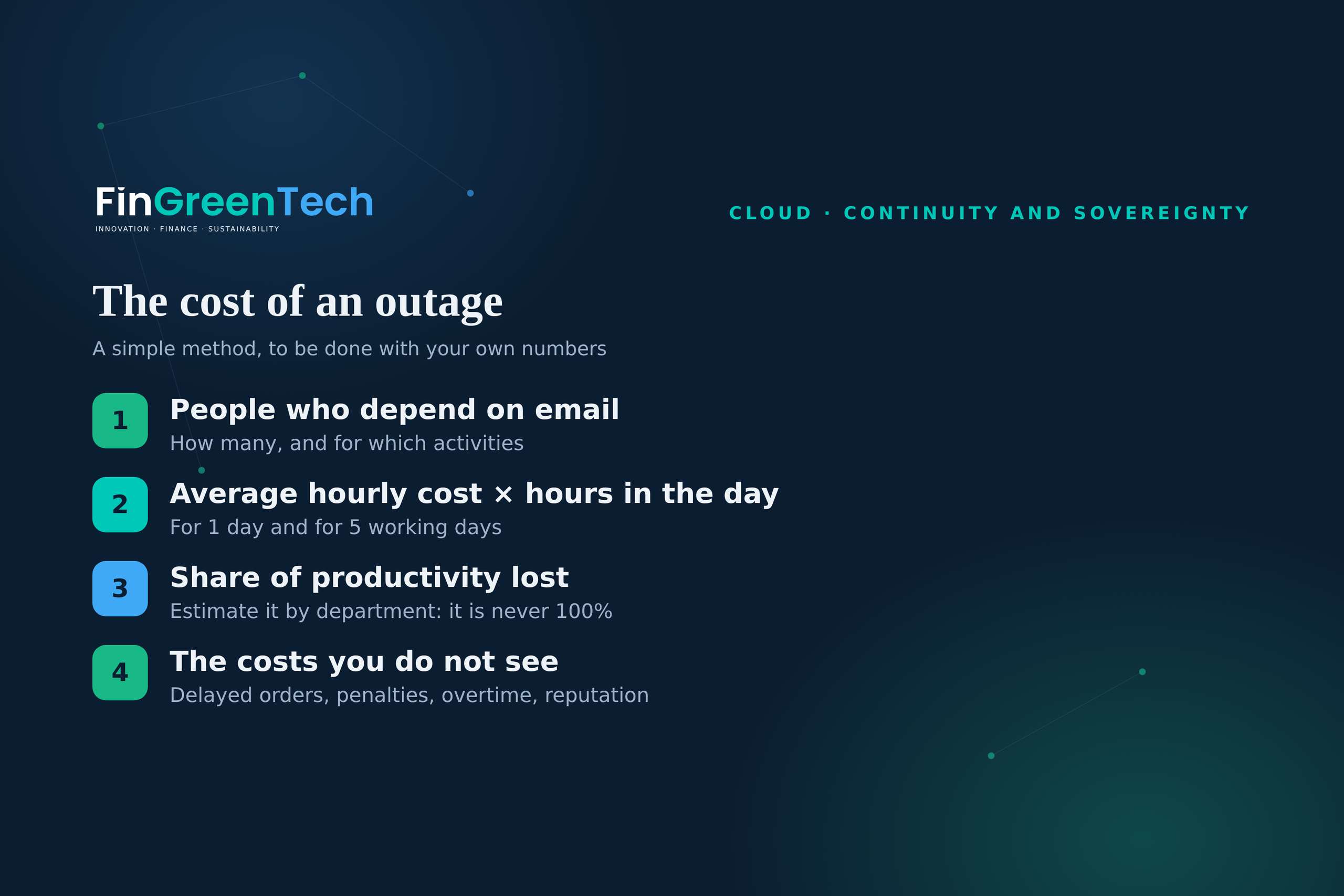
It is a question few companies can answer. A simple way to start is to estimate the cost of one working day without email and connected tools:
daily cost = people who depend on email × average hourly cost × hours in the day × share of productivity lost, plus the costs that do not show up as labour cost: delayed orders or files, penalties, lost revenue, overtime to catch up, alternative communication costs and reputational damage.
Every company has different numbers, so the method matters more than the figure. Work it out for one working day and for five, including the less visible items, and ask yourself how much you would expect to lose in the worst case. That is where you decide how much continuity you need: the question is not «how do I replace everything?» but «what is it worth to me to stay operational?»
The comparison with a backup solution should follow the same logic, taking into account not only licences but also infrastructure, migration and support. A 24-hour outage is an incident; a week-long one is an event that shows up in the accounts, and plan B should be sized accordingly.
5. Can business email be run in an alternative way?
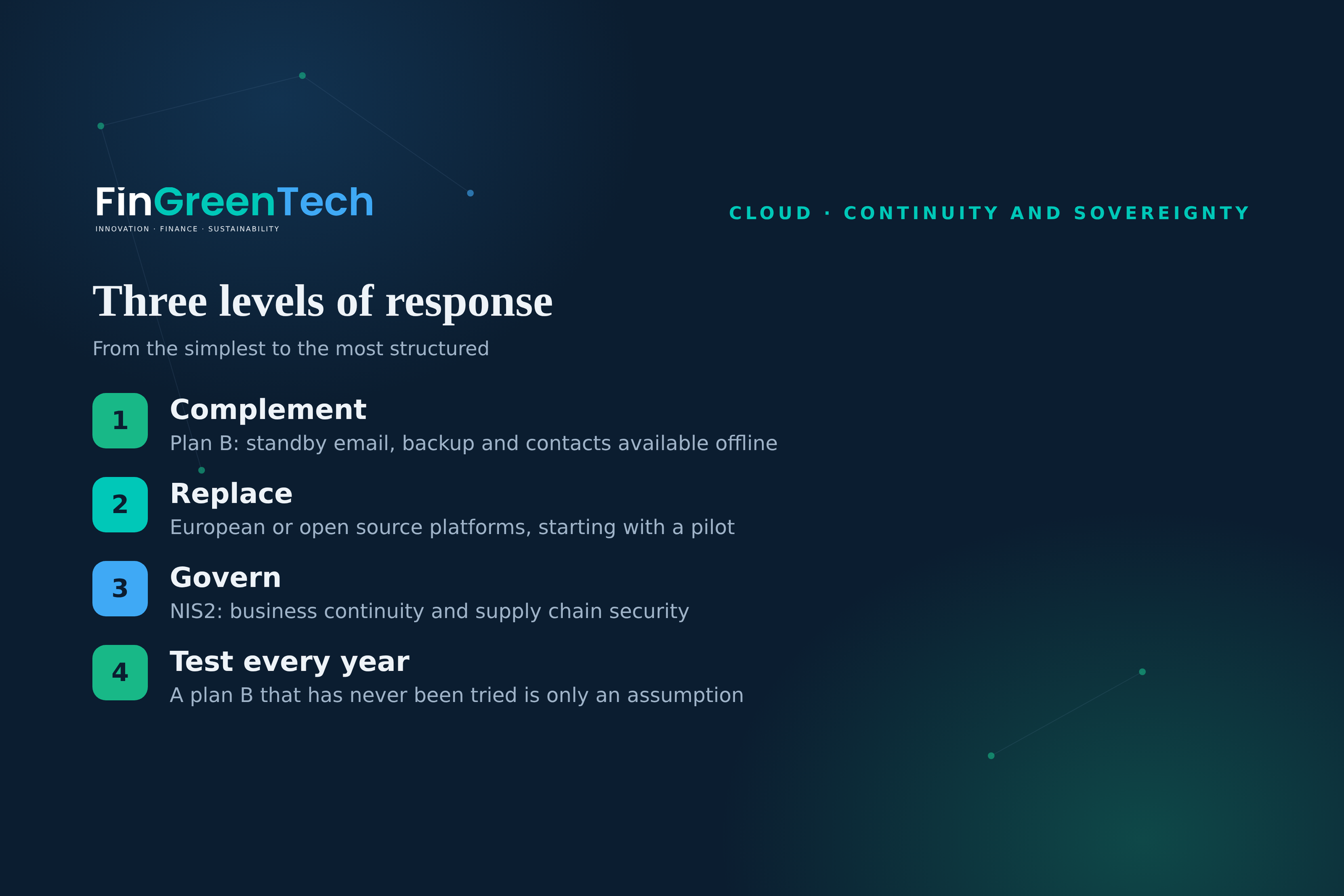
Yes, in two ways: complement or replace. Most people start with the first.
Complement: a plan B for continuity. Without changing your main provider, you can provide a standby service for emergency email, a backup of email and contacts outside the provider’s infrastructure, a list of key contacts available offline and an alternative internal channel. It is the quickest and least invasive route and covers most cases, which are outages lasting hours or a day.
Replace: a European or open source platform. A summary of some alternatives:
| Solution | Origin | What it replaces | Notes |
|---|---|---|---|
| grommunio | Austria | Exchange: email, calendars, contacts | Open source; Outlook works with native protocols; on a server or virtual machine; support through partners |
| Open-Xchange | Germany | Email and collaboration | Used by the German state of Schleswig-Holstein together with Thunderbird |
| Carbonio (Zextras) | Italy (Milan) | Email and collaborative workspace | Open source Community edition since 2024; commercial editions through partners |
| Nextcloud, openDesk | Germany | Files, documents, meetings, office suite | Open source, installable in-house or at a provider; openDesk chosen by the International Criminal Court |
| mailbox.org, Infomaniak, Proton, Tuta, Soverin | Germany, Switzerland, Netherlands | Email for small teams | Subscription services, simpler but less integrated with Microsoft |
The companies named are third parties: FinGreenTech has no direct interest in them and names them for their reputation and reach, as examples. The list is an orientation, not a recommendation, and for many solutions we only read the vendors’ documentation: you need a pilot, a compatibility check and an assessment of the support available in Italy. A European provider is not, moreover, more reliable by definition: the advantage lies in control, jurisdiction and not having a single point of failure. Finally, hosting email on a virtual machine in Italy is possible, but it means taking care of updates, backups and the reputation of sending servers: that is why it is best to be supported by a partner.
6. What those who have already switched teach us
The largest case is Schleswig-Holstein: since October 2025 the German state has migrated more than 40,000 mailboxes from Exchange to Open-Xchange and Thunderbird. Its government declares savings on Microsoft licences of more than 15 million euros a year from 2026, against a one-off investment of 9 million that the ministry expects to recoup in under a year (official figures reported by Heise, not an audit). The Financial Times confirms the order of magnitude, but notes that part of the saving goes to service providers and that a configuration fault, lasting almost three weeks, left some judges and police officers without email. The Austrian army (16,000 workstations on LibreOffice) and the Danish ministry (scaled-back pilot) have not published figures. The lesson: migrate in phases, keep a plan B during the transition and budget for services, not just licences.
7. Why it also concerns NIS2 and management’s duties
If your organisation is among the NIS2 entities (you can check in our vademecum on NIS news), Italian legislative decree 138/2024 makes dependency on a supplier a governance matter. Article 23 provides that management and administrative bodies approve how risk-management measures are implemented, oversee their application and are responsible for violations. Article 24(2) includes among the minimum measures business continuity, with backup management, disaster recovery and crisis management (point c), and supply chain security, including relationships with direct suppliers (point d); paragraph 3 requires taking into account the specific vulnerabilities of each supplier. An outage at an essential supplier is exactly the scenario in which those responsible will have to show they assessed the risk.
In the financial sector too, the European DORA regulation, applicable since 2025, requires supervised entities to manage the risk of critical ICT providers, including concentration risk, and to plan exit strategies. For details on individual obligations we refer you to the text of the regulation and to your legal adviser.
8. What to do this week
- Map your dependencies. Email, calendar, identity and access, files, meetings, backup: for each one, who is the provider and what happens if it stops.
- Estimate the cost of an outage with the formula above, for 1 day and for 5 days, and decide how much you are willing to tolerate.
- Prepare a minimum plan B: emergency contacts available offline, an alternative communication channel, a way to receive critical email and a copy of your data outside the main platform.
- Warn staff about phishing during outages: no email asking to «restore the mailbox» should be opened; only the provider’s official status page is checked.
- Consider a pilot on an alternative platform for a small group, and write an exit strategy, even if you do not expect to use it.
- Test the plan at least once a year: a plan B that has never been tried is an assumption.
Want to understand how much an outage would cost you and which plan B makes sense for your company? Book a free introductory call with FinGreenTech or write to info@fingreentech.com. We can also assess solutions that do not involve changing provider.
Sources: Office Watch, 16/11/2026 and Wccftech, 16/11/2026 (on Microsoft’s Preliminary Post Incident Report of 15/11/2026); PDF copy of the report published by Next.ink (not verified as the Microsoft original); Microsoft Learn, SLAs and service credits; ANSA, 13-14/11/2026; European Commission, technology sovereignty (Italian version); Agenda Digitale, «Sovranità digitale, l’Italia è la più attendista dell’UE: i fatti», 25/05/2026 (in Italian); Corriere della Sera, 13/11/2026; Euronews, 13/11/2026; The Register, 13/11/2026; TechRadar, live blog; Punto Informatico, 14/11/2026; Cyber Security 360, 14/11/2026; EconomyUp, «Blackout Microsoft, lo stress test che l’AI agentica non ha superato. La lezione? Va pianificata l’assenza», 13/11/2026 (in Italian); Agenda Digitale, «Microsoft 365 bloccato nel mondo: il rischio di dipendere da un solo fornitore», 13/11/2026 (in Italian); Agenda Digitale, «Sovranità digitale, la vera sfida è costruire le competenze», Andrea Laudadio, 29/09/2026 (in Italian); Red Hot Cyber, «E se domani gli USA spegnessero il cloud? Disservizio o staccare la spina è lo stesso», Carolina Vivianti, 13/11/2026 (in Italian); The Register, 25/07/2025; The Register, 31/10/2025; It’s FOSS, 10/10/2025; Heise, Schleswig-Holstein; Compare the Cloud, 19/08/2026; It’s FOSS, 01/10/2025; Irish Times (from the Financial Times), 04/04/2026; grommunio, pricing; Zextras Carbonio; Nextcloud, Euro-Office; Legislative decree no. 138 of 4 September 2024, articles 23 and 24 (Normattiva, in Italian). For the data on Italy: Osservatori Digital Innovation, Politecnico di Milano, slides of the event «Digital Sovereignty: between utopia and necessity», 17/11/2026.
Transparency note. This article was drafted with the support of artificial intelligence tools and reviewed by the FinGreenTech Team, which is editorially responsible for it.