
.
Over the past two years, generative AI has entered companies almost always the same way: a subscription to a cloud service, a web interface, and data leaving for servers whose location and lifecycle nobody really knows. It’s been the fastest way to adopt AI. But it isn’t the only way, and for many organizations it may not be the best one.
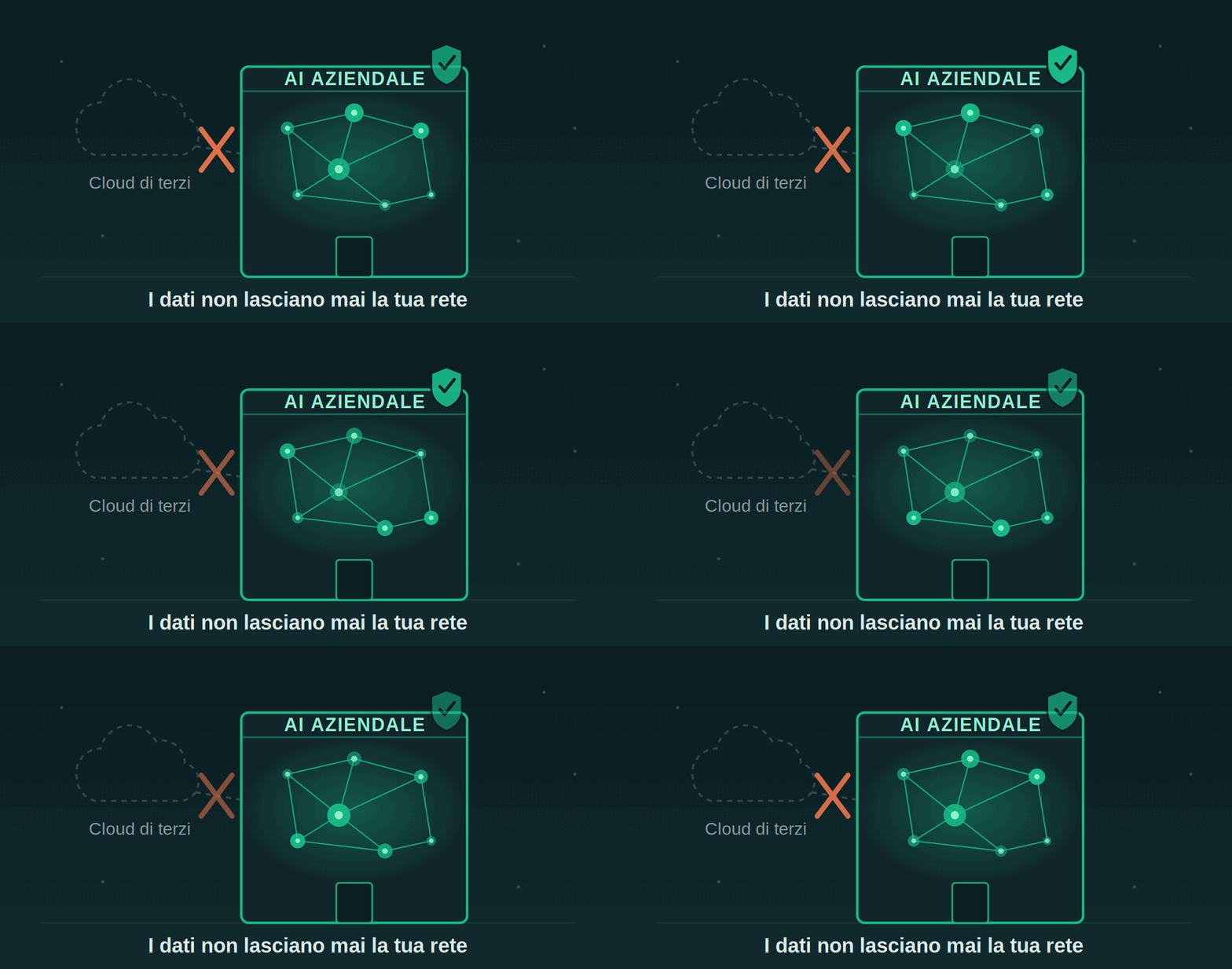
A concrete alternative is emerging: decentralized AI — language models and AI pipelines that run on infrastructure the company itself controls, whether on-premise, in a private datacenter, or directly on edge devices, without a single byte of company data ever touching a third-party cloud. This is no longer a research-lab idea: from institutions like the MIT Media Lab, which frames it as the paradigm needed to overcome the limits of centralized models, to the commercial platforms that now let AI models run locally on virtually any device, the ecosystem has matured.
The problem nobody wants to see
Today, AI development is concentrated in the hands of a few tech giants that control the three critical resources: massive datasets, specialized hardware, and expertise. Training a frontier model now costs hundreds of millions of dollars — a barrier that concentrates power and economic value in very few organizations, with little outside oversight.
For those who rely on these services, that concentration comes at a price. Every time an employee pastes a contract, a technical drawing, or a snippet of source code into a cloud AI, that information leaves the company’s perimeter. Centralized systems create what analysts call a honeypot effect: one single, massive data repository that, if breached, exposes everyone and everything at once. And the risk isn’t only digital. A telling case is Nayara, one of India’s largest fuel distribution networks, which lost access to all Microsoft services overnight because of international sanctions involving one of its shareholders — weeks without email or work tools, over a decision made in a completely different jurisdiction.
This is no longer just an observation from outside analysts: in July 2026, Microsoft CEO Satya Nadella said as much himself, warning companies that rely on proprietary models from the big AI labs. According to Nadella, businesses end up paying twice: once for the cost of using the service, and a second time by handing over their own data and internal knowledge through the customization process — the more a model is tailored to a company’s workflows, the more strategic information flows into it, turning into valuable organizational knowledge that ends up with the vendor instead of staying in-house. Nadella also raised the issue of model “distillation” — using an AI’s outputs to reverse-engineer how it works — calling it inconsistent that big labs train on everyone’s public data, yet block others from analyzing the outputs of their own systems. His prescription lines up with what’s pushing many companies toward decentralized AI: keep control of your own data, build proprietary environments for learning, and adopt multi-model setups so you’re not locked into a single vendor.
For a European company, the risks fall into three areas:
Compliance and data sovereignty. With GDPR, and now the EU AI Act, data sovereignty is no longer a marketing slogan — it’s an audit question. High-risk AI systems must meet concrete obligations on data governance, technical documentation, and human oversight. Anyone running AI through a stack whose data flows they don’t control inherits all the unknowns: where the data actually sits, which foreign laws might reach it, and which model version produced which decision.
Intellectual property and patents. Know-how is often a company’s real asset. R&D documents, formulas, production processes, proprietary code: sending them to an outside service, even just to have them summarized, means exposing them. With a local model, trade secrets never leave the company network.
Vendor dependency. Prices change, models get deprecated or pulled, usage caps shift, contract terms are set unilaterally. Even the distribution of open-source models today largely depends on a single hub subject to U.S. jurisdiction — which is why peer-to-peer networks for distributing model weights in a verified, censorship-resistant way are starting to emerge in the open-source community. Building critical processes on top of a rented AI means building on someone else’s ground.
How an “in-house” AI actually works
The technology is mature. Open-source models, now close in quality to proprietary ones, can run on company-owned hardware, and dedicated frameworks make it possible to orchestrate them even on everyday devices: hardware-agnostic inference engines now run on virtually any GPU, and fine-tuning a model is even possible on mobile devices. The underlying principle is simple, and it’s the same one Nadella pointed to: artificial intelligence is no longer a service to rent, but an asset — a “proprietary environment” for learning — that a company can actually own.
What makes a local model genuinely useful in a business setting is RAG (Retrieval-Augmented Generation): the model is connected to the company’s own documents — shared folders, management systems, knowledge bases — and answers by drawing on that information, with responses relevant to the organization’s specific context. The result is an AI assistant that knows your company, speaks about your processes, and does so without anything ever leaving your infrastructure.

Alongside local deployment, even more sophisticated collaborative approaches exist. Federated learning lets multiple organizations train a shared model together without ever pooling raw data: each participant trains locally and shares only the model updates. This is already reality in healthcare, where hospitals train diagnostic models on their own patients without violating their privacy, and in finance, where banks build fraud-detection networks by sharing anomaly signals rather than customer data. Cryptographic techniques such as zero-knowledge proofs and trusted execution environments also make it possible to verify that a computation was carried out correctly without revealing the underlying data or parameters — a concrete answer to the “black box” problem.
The advantages, in short
- Data sovereignty: everything stays within the company’s perimeter, subject to local law, with full control over access, logs, and retention. Privacy by design, not by contractual promise.
- Predictable costs: an upfront investment in hardware and development, instead of a recurring operating cost that grows with usage and that the vendor can adjust at any time.
- Deep customization: with open-source models on your own infrastructure, you control the model itself, not just the interface on top of it. It can be replaced, adapted, and trained on your own data.
- Resilience and business continuity: removing the single point of failure means the AI keeps working even without external connectivity — essential for industrial, healthcare, or high-security environments, and a safeguard against geopolitical risk.
- Lower latency: centralized cloud is bound by the laws of physics and the speed of light; local inference happens close to the data, with no round-trip to a remote datacenter.
The trade-offs, without sugarcoating
It would be dishonest to present decentralized AI as a cost-free choice. Models that run on-premise, however fast they’re improving, still don’t match frontier models from the big providers on every task. It requires adequate hardware — typically dedicated GPUs — and the technical literature is unanimous about the real difficulty: orchestration complexity. Coordinating models, updates, versions, and policies across a distributed infrastructure is technically demanding work, with performance that can vary with the hardware and new attack surfaces to defend.
Above all, it requires design expertise: choosing the right model, building the RAG pipeline, integrating with existing company systems, securing the infrastructure, and maintaining it over time. This isn’t an off-the-shelf product. It’s an engineering project, one that calls for a proper analysis of use cases, design that’s integrated with the company’s IT, and a technology partner able to support the whole lifecycle.
A new frontier, and a new dilemma
The numbers say the time to decide is now: according to Gartner, by the end of 2026, 40% of enterprise applications will have dedicated AI agents built in (up from under 5% the year before), yet 60% of organizations won’t realize the value they expect from their AI projects by 2027, for lack of coherent governance frameworks. The real divide isn’t between companies that use AI and those that don’t — it’s between those who use an AI they can actually govern and those who don’t.
Decentralized AI opens up a genuinely new strategy, and in some ways a democratizing one: for the first time, small and mid-sized businesses can also have access to proprietary AI capabilities, aligned with their own confidentiality constraints, without handing the core of their information assets to a third party — an opportunity the MIT Media Lab explicitly points to as a lever for spreading innovation beyond the big players.
The dilemma facing businesses is real, and the most credible answer is a hybrid future: for many general-purpose uses, the cloud will remain the rational choice, while large centralized models will keep dominating large-scale training. But for anything touching sensitive data, intellectual property, and core processes, the question every company should be asking has changed — and it’s the same one now being raised by the head of one of the world’s largest cloud providers. No longer “which AI do we use?”, but “where does our AI live, and who controls the data?”
Whoever answers that question first will have a competitive edge that goes beyond technology: they will have turned AI from a rented service into a company asset.
The advantages, at a glance:
| Business challenge | Centralized Cloud AI (US/third-party) | Decentralized AI (on-premise/local) |
| GDPR / AI Act compliance | Risk of data transfer outside the EU | Full local control over data |
| Trade secrets | Data sent to third-party servers | Know-how never leaves the network |
| Business continuity | Dependent on connectivity and licenses | Resilient even without external network |
Want to know more?
At FinGreenTech we support companies through this whole journey: from use-case analysis to infrastructure design, all the way to integrating local AI assistants with existing company systems — an area where we already have hands-on experience, having built AI assistants on local infrastructure with RAG pipelines for our clients.
If you want to understand what a dedicated AI could do for your organization, without your data ever leaving your network, get in touch for a no-obligation assessment.
📋 Methodology: this article was produced with AI assistance.
Human validation: FGT Strategy & Communications Team